
Peer Power
The Questions You Can't Google - Part 3


Is my co-founder feeling the same pain I am?
This is a question that comes up more often than you would think, maybe not in pitch meetings or investor updates, but in the quieter moments, say, late at night, after a bad week, when you are running on fumes, and you look across at your co-founder or your early team and wonder: do they care about this as much as I do? Are they carrying the same weight? Or am I doing this alone?
It is one of the most human questions in the founder journey. It is also one of the most dangerous, because how you answer it, and more importantly, how you act on that answer, can either strengthen your founding team or completely destroy it.
The structural reality
Let me start with something that needs to be said as plainly as possible: as a founder, you will always feel more pain than anyone else. Always.
This isn’t some ‘special’ flaw in your team, as in, it isn’t only happening with ‘you’. It is structural as you carry the financial risk, the existential risk, the reputational risk, and the long term responsibility. The company is your baby. For good or bad, your identity is fused with it in ways that even a deeply committed co-founder or early employee will never fully match. And, truth be told, that’s okay. It is how it will be.
It is also quite possible that within a founding team, one founder feels the burden more than the other. That probably reflects something about who they are in the founding relationship, say their role, temperament, or stage of life. But, mind you, it doesn’t automatically mean the other person isn’t pulling their weight.
The mistake I see founders make, over and over (sadly), is treating this as a betrayal. They feel the weight, they look around, they don’t see the same level of ‘visible’ suffering in their co-founder, and they conclude: this person doesn’t care enough.
That conclusion is almost always an emotional response, not an evidence based one. The gap between those two things is where founding teams fracture.
The paranoia cycle
Let me dig in a bit deeper. Here is what usually happens. It follows an almost predictable pattern.
A founder is overloaded. By virtue of being overloaded, they start to feel that others are not as overloaded, and therefore are not as committed. They start judging the effort others are making. Slowly, the trust they have placed in their co-founder or key team members starts to pull back.
The team notices, but they may not know exactly what has shifted. They can feel the disconnect. As a result, their performance drops, not because they have stopped caring, but because the dynamics have changed. Trust has eroded, and people perform differently when they sense they are being doubted.
This is the unintentional consequence of founder paranoia. The very thing you feared - that your team isn’t committed enough - becomes a self fulfilling prophecy. Not because it was true, but because your response to the fear made it true.
The only way to break this cycle is to rebuild trust. I mean, trust in both directions: structural trust through clear roles and expectations, and emotional trust through honest conversation.
But there is another thing I would ask any founder sitting with this feeling. Before you judge the other person, look at yourself first. When does this doubt tend to creep in? In my experience, it’s almost always when you’re mentally exhausted, personally stretched, or in a bad state. Mental fatigue creates distrust the way a mirage creates water. It looks completely real, but it’s not actually there. Your rationality has left the building.
Sometimes the weight of leadership means the problem isn’t the other person at all. Sometimes it’s just you, running on empty, projecting your exhaustion onto everyone around you. That introspection am I feeling this because it’s real, or because I’m burnt out? is just as important as any assessment of your co-founder.
The trust equation
A founder friend recently brought up something that I think gives useful structure to all of this. There is a concept called the Trust Equation, originally developed by David Maister, Charles Green, and Robert Galford in their book ‘The Trusted Advisor’. It was written for professional relationships, and, as you can guess, it maps well onto co-founder dynamics.
The equation is simple: Trustworthiness equals Credibility plus Reliability plus Intimacy, divided by Self Orientation.

Let me translate that into founding team language.
Credibility is competence: does your co-founder actually know what they are doing in their domain? Can they be believed when they say they will handle something?
Reliability is consistency: do they follow through? Do their actions match their words over time?
Intimacy is the safety to be honest: can you have real conversations with this person? Can you say “I don’t know” or “I am struggling” without it being used against you?
Self Orientation, the denominator, is the one that changes everything. The more someone is optimizing for themselves, as in, their title, their ego, their personal outcomes, the more it divides and erodes every other element. You can be credible, reliable, and emotionally safe, but if your co-founder senses you are fundamentally in it for yourself, trust collapses.
What I find powerful about this framing is that it makes trust diagnosable. When trust is eroding between co-founders, it’s usually not some vague “we don’t get along.” It’s that one of these four components has broken. Maybe competence was never there, or maybe reliability has slipped, or maybe you have stopped being honest with each other, etc. Identifying which component is broken gives you something specific to work on, rather than just sitting with a general sense of unease.
Measure ownership, not pain
With that said, I truly believe the reframing every founder needs is to stop measuring ‘pain’ and start measuring ownership.
Pain is emotional. It’s invisible, subjective, and impossible to ‘compare’. You have no idea what someone else is actually feeling, and even if you did, ‘matching’ pain levels isn’t what builds companies.
Ownership, on the other hand, is observable. It shows up in specific behaviour. Does this person take initiative and solve problems without waiting for permission or direction? Do they demonstrate instincts to protect the company? When things break, do they step up and defend? Are they responsible for outcomes, not just tasks? Do they think long term, or are they optimizing for themselves and their role?
These are the things that actually matter, and they are actually measurable. You can point to them, discuss them, and build around them.
The question founders should be asking isn’t “does my co-founder feel the same pain I do?” It’s “is this person acting like the owner of what they need to deliver?” Because startups are not built on emotional ownership but are rather built on behavioral ownership. That distinction is everything.
There is a simple thought experiment that helps clarify this: if your co-founder or key team member left tomorrow, would the company be meaningfully weaker? Would you really, viscerally feel the impact? If the answer is yes, then regardless of whether their pain looks like yours, they are clearly contributing something essential.
If the answer is no, as in, if the person leaving wouldn’t fundamentally change anything, then you might have a genuine ownership misfit. But that’s a very different problem from “they don’t seem as stressed as I am.”
The three personas in every founding team
I want to spend a moment on something that I think explains a lot of the tension founders feel but rarely name.
In any founding team, people tend to fall into one of three roles. Not formally, not by title, but by temperament.
The visionary: This is the person who carries the narrative. Think of them as the big picture thinker, out there inspiring people, setting the most ambitious goals, always pushing for the next leap. They are relentless, impatient with slow execution, and always building the story of what the company can become. Their burden is the pressure of existence: does this thing deserve to exist, and can I make it real?
The builder: This is the operator. They are the person who turns the visionary’s thinking into real systems and processes. Product development, hiring, execution rigour, that’s their domain. They thrive on making things work, and they get frustrated when they can’t marry the vision to execution. Their burden is execution pressure: can I actually deliver what we have promised?
The anchor: This is the person who protects the company. Think financial discipline, risk management, team stability, they are the backstop. They make sure the visionary’s ambition and the builder’s velocity don’t tip the company into reckless territory. They are more risk averse by instinct, and their flashpoints are always about pushing back and being more measured. Their burden is the weight of protection: can I keep this thing from breaking?
So, you have three very different people, carrying three very different burdens, showing up in three very different ways. The question is: how do they hold together? I have been thinking about an analogy that I believe captures this well.
The ‘Vitruvian’ founder
Think about Da Vinci’s Vitruvian Man. The image is famous, but the philosophy behind it is what matters here. It’s about proportion, harmony, and structural balance.
A founding team works the same way. The circle is vision, creativity, ambition, the raw energy that pulls a startup forward. The square is structure, discipline, financial control, the systems that keep it from coming apart. The best teams don’t perfectly balance the two. They operate in the tension between them. Too much circle, and you get motion without direction, or, too much square, and you get control without momentum.
But here’s the insight that I think matters most: the Vitruvian Man was never about all dimensions being identical. It was about all dimensions being in proportion. And that’s exactly how founding teams should think about the balance between co-founders. The pain, the commitment, the sacrifice, none of it has to be equal. It has to be proportional. Proportional to the role you play and proportional to where you are in the journey.
A visionary’s burden looks like existential anxiety about whether this thing deserves to exist. A builder’s burden looks like execution pressure — can I actually deliver what we have promised? An anchor’s burden looks like constant vigilance — can I keep this from breaking? All three are real. All three are heavy. They are just different. And the founding team holds together not when everyone carries the same weight, but when the proportions are in harmony.
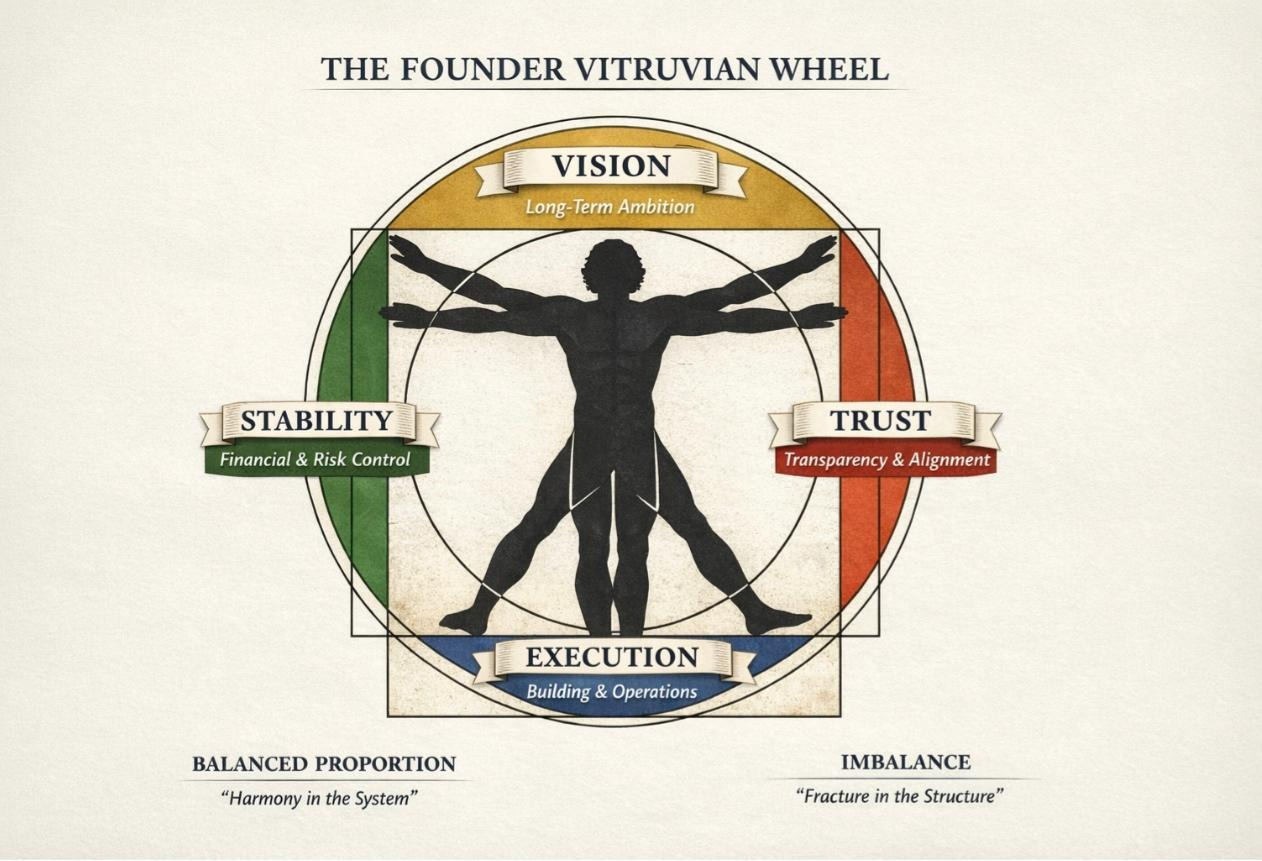
Note: This is a AI generated. It isn’t perfect, but it gets the point across.
If you strip it down: the circle represents what is natural and instinctive — the vision, the creativity, the ambition that pulls a company forward. The square represents what is deliberate and constructed — the discipline, the financial rigour, the operational systems.
The founding teams that work best are not the ones where everyone is the same. They are the ones where different personas are in the right proportion, and where each person understands that their co-founder’s burden is just as real, even if it doesn’t look like theirs.
Remember: Not equal. In proportion.
Where things actually go wrong
Based on what I’ve seen, founding relationships tend to break down in a few specific places. They are almost always avoidable.
Unstated expectations: This is without doubt the biggest one. It’s never the stated expectations that cause problems. It’s the things you assumed but never said. “I’m all in” sounds like alignment, but all in to you could mean something completely different from all in to your co-founder. It could mean different levels of sacrifice, different time commitments, different financial expectations. If you haven’t scratched beneath the surface of what “all in” actually means: how long, what sacrifices, what you expect from each other, you are building on ambiguity, and ambiguity in a founding relationship is a ticking clock.
Blurred ownership: A lot of the emotional reaction to feeling like others are not pulling their weight comes from unclear responsibilities. “You were supposed to do it.” “I thought you were doing it.” “You never told me I was supposed to.” When ownership zones are undefined, everything feels like a failure of commitment. But it’s actually a failure of clarity. Each co-founder needs a defined domain, clear authority, and clear outcomes they are responsible for. The ambiguity is what creates the relationship hurdles.
Equity that doesn’t match sacrifice: This is uncomfortable, but it has to be said. Most co-founders default to equal splits because it’s the easiest, least disruptive option. But over time, if one person feels they are sacrificing more, doing more, carrying more, an equal split starts to feel deeply unfair. That resentment compounds quietly. This is exactly why reverse vesting exists. It ties equity to continued commitment and performance rather than treating it as a one time allocation. Having these conversations about rebalancing early, before resentment sets in, is far better than avoiding them.
Sitting in silence: This is the killer. A founder starts to feel doubt about their co-founder’s commitment, yet they don’t say anything. The doubt creeps in further and trust erodes. By the time they actually address it, the relationship is already damaged beyond easy repair. A lot of startup failure, honestly, comes from co-founder failures and not failures of product or market. Also, most co-founder failures don’t come from a dramatic conflict. They come from unspoken issues and doubt that were never surfaced. Once you have concluded, in your own head, that your co-founder doesn’t care enough, trust completely erodes. From that point on, there is very little interest in trying to solve anything.
What actually helps
If you are feeling this tension, here is what I would suggest.
Have the hard conversation: But not when you are angry or exhausted, but deliberately. Revisit whether you are still on the same mission. Ask openly if the excitement has changed. Ask what “all in” means today, because it may have evolved. Burnout changes people, life changes change people, and what was true when you started may not be true, say 18 months in. Regular, honest check ins between co-founders are not optional, it has to be built into the functioning infrastructure.
Define roles with painful clarity: Who owns what? What are the outcomes each person is responsible for? Where does one person’s authority start and another’s end? This is the thing that prevents the bleeding of responsibility that causes most of the resentment.
Look at the observable, not the emotional: When the doubt creeps in, come back to behaviour. Is this person taking initiative? Are they protecting the company? Are they delivering on their outcomes? That’s what matters. Not whether they look as stressed as you.
Reframe the question: The most productive version of this question isn’t “do they feel the same pain I do?” It’s “are they acting like the owner of what they need to deliver?” That reframe alone, from emotional intensity to behavioural ownership, tends to give founders a much clearer, more tangible answer.
What we look for as investors
I will close with what we observe from the other side of the table, because I think it’s useful for founders to know what investors are actually assessing when they meet a founding team.
We want to know: will these people be there for the long haul? Can they build a company together? These are late outcomes in early businesses, so we are looking for leading indicators.
Stress resilience: How do these people deal with things when they go wrong? Are they a team that discusses openly, or one that avoids difficult conversations? A fragile team avoids hard topics and runs on emotion. A strong team addresses things directly.
Decision velocity: How quickly does this founding team make hard decisions collectively, say, firing an early employee, going out to raise in a bad market, cutting a product line, and how quickly do they execute those decisions without second guessing? Startups require decisions made with incomplete information. The teams that deliberate endlessly or relitigate after committing are the ones that worry me.
Aligned ambition: Are they talking about the same goal? “We want to build a large company” means nothing if large means 50 million to one co-founder and a billion to the other. Just like “all in,” “large” needs to be defined. Misalignment in ambition is one of the quietest and most destructive forces in a founding team.
The loyalty test: What do they say about each other when the other person isn’t in the room? Do they defend each other? Do they frame decisions as collective? A great founding team, even if the individuals are very different personas, will say: “We debated it together, we discussed it, we came to a joint decision.” It’s the subtle signals: how much they truly value each other that tell you the most about whether this team will last.
The question behind the question
I want to end by going back to where this started. “Is my co-founder feeling the same pain I am?” is the question founders ask. But it’s not actually the question they need answered.
The real question is: can I trust this person to build this with me?
Trust, as I have highlighted, isn’t about matching emotional intensity. It’s about credibility, reliability, honest communication, and a genuine orientation toward the company over oneself. It’s about proportional commitment, not identical commitment.
Vitruvian balance - different dimensions, different strengths, different burdens, held together by structure and proportion rather than by everyone suffering in the same way.
The founding teams that last are the ones where the pain is acknowledged, the roles are clear, the conversations are honest, and each person’s contribution is understood for what it is and not measured against someone else’s.
If you are sitting with this question right now, the most important thing you can do is not to let it fester in silence. You must surface it, diagnose it, and, more importantly, build the necessary structures that let trust compound rather than erode.
Because the real risk was never that your co-founder feels less pain than you. The real risk is that the doubt you carry about it, unspoken, slowly becomes the thing that breaks a team that could have actually gone the distance.